Electrostatics and Magnetostatics – Unit-1 Detailed Notes
Electrostatics and Magnetostatics – Complete Notes in Easy Language
Meta Description (SEO):
Learn Electrostatics and Magnetostatics in easy language. Covers vector calculus review, Coulomb’s law, electric displacement, Gauss’s law, electric potential, dipole field, Poisson and Laplace equations, capacitance, energy in electrostatic fields and boundary conditions.
1. Introduction to Electrostatics
Electrostatics physics ka wo branch hai jisme hum stationary electric charges (jo move nahi kar rahe) ka study karte hain।
Is topic ka use capacitors, transmission lines, electric field analysis jaise areas me hota hai।
2. Review of Vector Calculus (Basic)
Electromagnetics me quantities vector form me hoti hain (magnitude + direction)।
Important Vector Operations
Gradient (∇V) → potential se field nikalna
Divergence (∇·D) → field ka source/sink
Curl (∇×E) → rotational nature
👉 Ye concepts aage Gauss, Poisson, Laplace me kaam aate hain।
3. Coulomb’s Law

Coulomb’s law batata hai ki do charges ke beech force kitna hoga।
Statement
Two point charges ke beech force unke charges ke product ke proportional aur distance ke square ke inversely proportional hota hai।
Formula
👉 Same charge → repel
👉 Opposite charge → attract
4. Electric Displacement & Displacement Density (D)
Electric displacement vector D material medium ke effect ko include karta hai।
Relation
Where:
E = electric field
P = polarization
👉 D ka use Gauss’s law me hota hai।
5. Lines of Force & Lines of Flux

Lines of Force
Electric field ki direction show karti hain
Positive charge se start, negative par end
Lines of Flux
Electric flux ko represent karti hain
Field strength ka idea deti hain
6. Gauss’s Law

Statement
Kisi closed surface se total electric flux = enclosed charge / ϵ₀
Mathematical Form
👉 Highly symmetric cases (sphere, cylinder) ke liye useful.
7. Electric Potential & Potential Function
Electric potential ka matlab hai unit charge ko infinity se kisi point tak lane me required work।
Relation
👉 Potential scalar hota hai
👉 Field vector hota hai
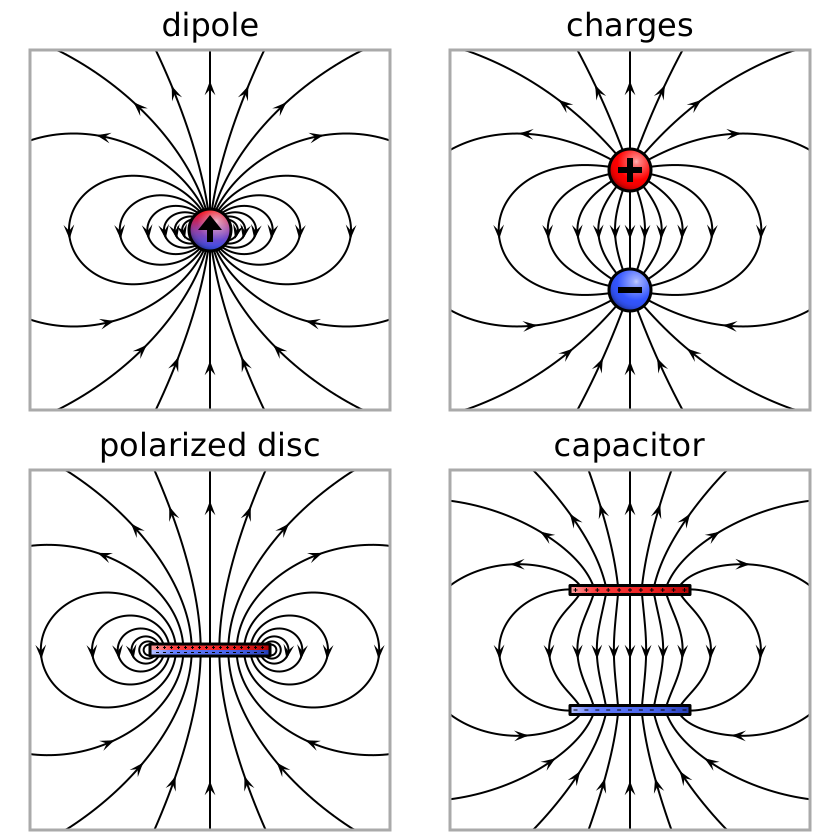
8. Field of an Infinitesimal Electric Dipole
Electric dipole = equal & opposite charges with small separation.
Dipole ka field:
Axial line par maximum
Equatorial line par kam
9. Field Due to Continuous Charge Distribution
Jab charge line, surface ya volume me distributed ho, tab:
Line charge density (λ)
Surface charge density (σ)
Volume charge density (ρ)
Field ko integration se calculate kiya jata hai।
10. Equipotential Surfaces

Equipotential surface wo surface hoti hai jahan:
Potential same hota hai
Electric field uske perpendicular hota hai
Work done = 0
11. Divergence Theorem
Statement
Volume ke andar divergence ka integral = surface flux
Equation
👉 Gauss’s law ko volume form me convert karta hai।
12. Poisson’s & Laplace’s Equation
Poisson’s Equation
Used when charge density ≠ 0
Laplace’s Equation
Used when region charge-free ho.
13. Solution by Method of Electrical Images

Complex boundary problems ko simplify karne ke liye imaginary charges assume kiye jate hain।
👉 Conducting plane + point charge problems me use hota hai।
14. Capacitance
Capacitance ka matlab hai charge store karne ki ability।
Formula
Unit: Farad (F)
15. Capacitance of Parallel Plate Capacitor
Where:
A = plate area
d = separation
16. Capacitance of Coaxial Cable

Used in communication systems.
17. Energy in Electrostatic Fields
Electrostatic field me energy stored hoti hai।
Energy Density
👉 Capacitors me energy store hoti hai।
18. Boundary Conditions
Boundary conditions batati hain ki interface par fields ka behavior kaisa hoga।
Tangential E continuous
Normal D discontinuous (surface charge present ho to)
👉 Ye dielectrics & conductors ke liye important hai।


Comments
Post a Comment